
Kia Cerato replacement parts
Kia Cerato Generations, Bodies & Markets
Identify a Cerato or Forte from its production label, original market and body, not its badge alone.
Generation and body boundaries
| Generation | Context | What changes |
|---|---|---|
| LD | Earlier Cerato sedan and hatchback applications | Identify the original build market and engine. Diesel service parts, legacy timing drives and hydraulic steering must not be selected from later Forte specifications. |
| TD | Cerato/Forte sedan, hatchback and Koup records | Record the full body description; two-door Koup doors and closures are not four-door sedan parts. Historical LPi hybrid requests need separate powertrain identification. |
| YD | Cerato/Forte and regional K3 applications | Separate MPI, GDI and turbo equipment, regional front-end designs and facelift. A shared sales name does not confirm interchangeable lamps or panels. |
| BD | Later Cerato/Forte applications | Identify the exact market and trim. US GT uses different powertrain and rear suspension from GT-Line; some regional specifications also differ in rear brake equipment. |
| Other regional names | Newer K3 or K4 vehicles | Do not order against a legacy Cerato/Forte record solely because the vehicle wears a K3 badge. Confirm the original model code before combining an inquiry. |
Resolve Cerato, Forte and K3 names
K3 has also been used on different regional vehicles. Keep the complete model designation on the inquiry so a name used in one country does not become an interchange claim in another.
Keep the three body styles distinct
Four-door sedan, five-door hatchback and two-door Koup inquiries need different body records. The rear closure, lamp arrangement, glass travel and door hardware can change even within one generation. Photograph the complete side and rear of the vehicle before selecting collision or door assemblies.
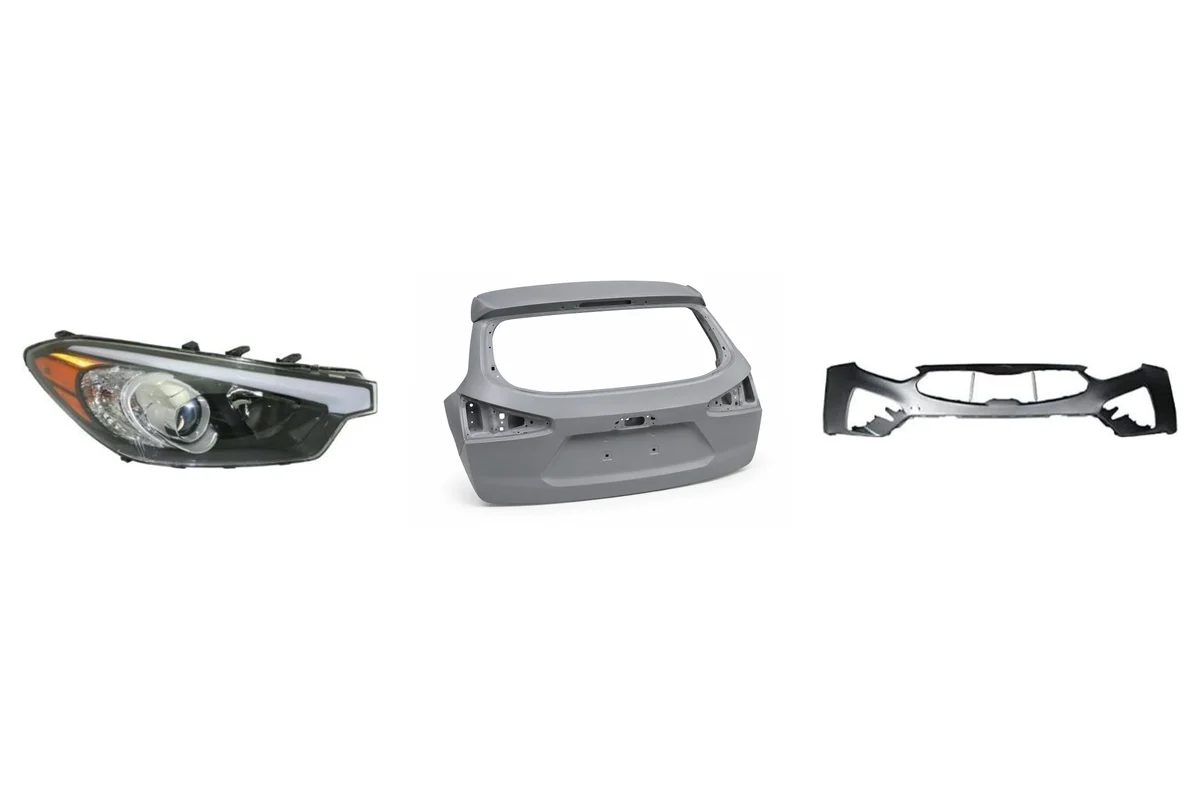
Match the Front Bumper and Headlights to the same regional front-end design before approving a collision-parts order.
Use generation together with build details
LD, TD, YD and BD are useful catalog starting points, but launch and replacement dates vary by market. Match the build date and regional front-end design rather than treating a registration year as a worldwide cut-off. Compare inner mounting points as well as the visible panel shape.
Separate an alias from a replacement model
A newer regional K3 or a K4 requires its own identification record until the actual assembly is confirmed. Keep such requests on separate order lines. Within verified Cerato/Forte applications, retain engine, transmission and installed features alongside the body record.
Components to identify separately
| Assembly | Selection evidence |
|---|---|
| Headlights | Cerato/Forte body and facelift, LH/RH, beam market and halogen or LED equipment |
| Front Bumper | Facelift, regional body, grille shape and sensor apertures |
| Rear Bumper | Body length, reflector positions, exhaust openings and sensors |
| Steering Rack | Rack-equipped generation, LHD or RHD and assist type |
| CV Axle | Side, transmission output, spline and shaft length |
| Rear Axle Beam | CTBA rear suspension only; hub mounts, spring seats and brake fittings |
Continue your parts list
Return to the Cerato parts directory for other systems. The OE and VIN checklist covers missing identification, while the quotation guide covers commercial and freight information.
Auto parts inquiry
Send the vehicle and part evidence.
Include brand, full model, year, engine or EV drivetrain, OE/material code, quantity, destination and packing request. You can attach a list or old-part photos.