
Kia Rio replacement parts
Kia Rio Generations, Bodies & Markets
Start a Rio parts order with the production label, original sales market and complete body description.
Generation and body boundaries
| Generation | Context | What changes |
|---|---|---|
| Early Rio | Older sedan and hatchback records | Use the production plate and original catalog identity; do not select legacy timing or hydraulic-steering parts from a current-model photo. |
| JB family | Second-generation sedan/hatchback context | Confirm body, engine, steering assistance and belt/chain architecture from the installed vehicle. |
| UB family | Third-generation regional applications | Record three-door, five-door or sedan body as applicable, petrol/CRDi engine and rear brake equipment. |
| Later Rio families | YB and region-specific sedan/hatchback identification | Keep the complete regional model code, body and facelift. Similar sales names do not prove shared panels or lamps. |
| 48V-equipped Rio | Selected petrol mild-hybrid applications | Identify starter-generator and iMT/DCT equipment separately; mild hybrid is not a HEV or PHEV parts specification. |
Build one reliable vehicle record
The registration date helps locate a vehicle but cannot replace the build record. Keep photographs of the vehicle and component together so different Rio applications do not become mixed in one inquiry.
Count doors before selecting body equipment
A sedan trunk lid and a hatchback rear door have different glass, lamp and latch interfaces. Three-door and five-door hatchbacks also need separate door and window-regulator identification. Record the actual door position before approving mirrors, latches or glazing-related hardware.
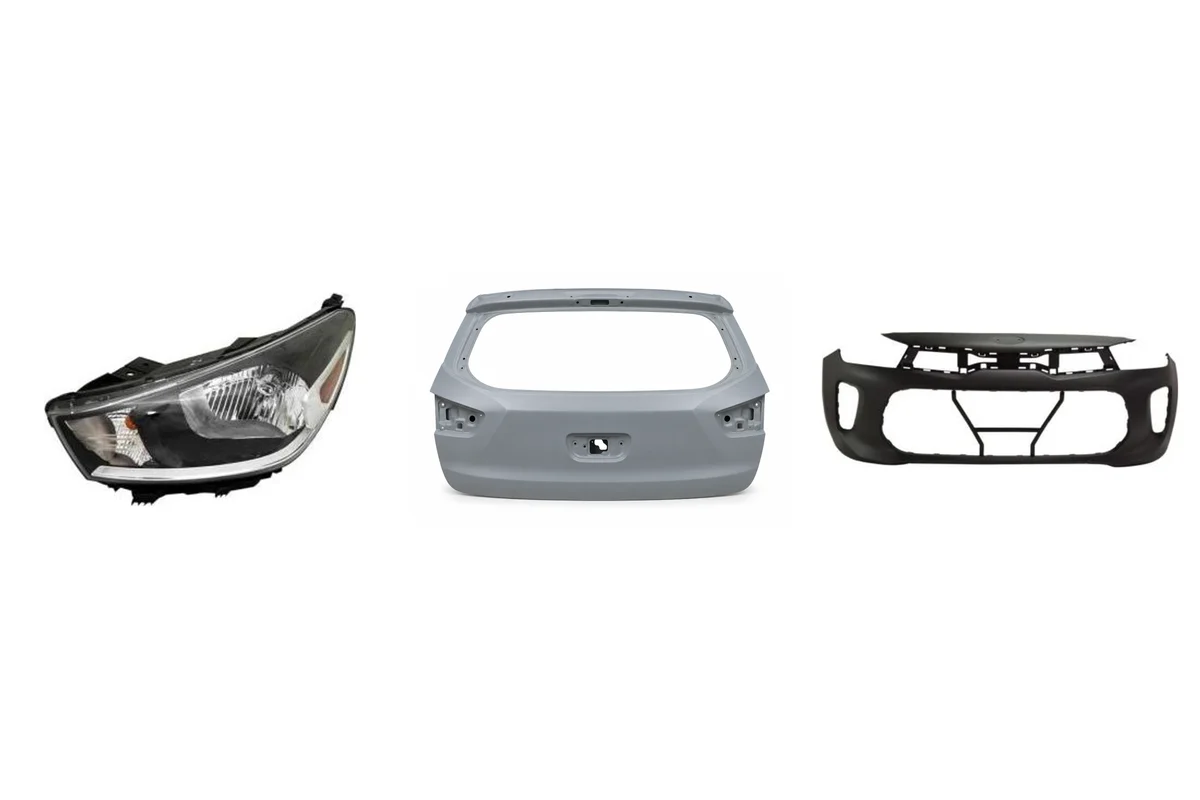
Match the Front Bumper and Headlights to the same regional front-end design before approving a collision-parts order.
Treat regional names as search clues
A familiar Rio badge or a regional suffix helps locate a catalog, but it does not establish parts interchangeability. Keep the complete model code rather than shortening every regional record to YB. Front-end photographs should show bumper, grille and headlamp junctions together.
Keep old applications visible
Older Rio vehicles may have different steering assistance, timing drives or rear brake equipment from later cars. Match the installed assembly instead of assuming that the newest catalog illustration represents all earlier years. Use a separate inquiry line when any body or mechanical identification changes.
Components to identify separately
| Assembly | Selection evidence |
|---|---|
| Headlights | Body generation, facelift, side, beam market and lamp technology |
| Front Bumper | Facelift, regional body, grille shape and sensor apertures |
| Rear Bumper | Body length, reflector positions, exhaust openings and sensors |
| Steering Rack | Rack-equipped generation, LHD or RHD and assist type |
| CV Axle | Side, transmission output, spline and shaft length |
| Brake Drums | Rear drum equipment, internal diameter and hub or ABS format |
Continue your parts list
Return to the Rio parts directory for other systems. The OE and VIN checklist covers missing identification, while the quotation guide covers commercial and freight information.
Auto parts inquiry
Send the vehicle and part evidence.
Include brand, full model, year, engine or EV drivetrain, OE/material code, quantity, destination and packing request. You can attach a list or old-part photos.