
BYD Seal electric sedan
BYD Seal Cooling & Cabin Climate Parts Guide
Separate the Seal coolant circuit, refrigerant circuit and cabin-air equipment when preparing a thermal repair order.
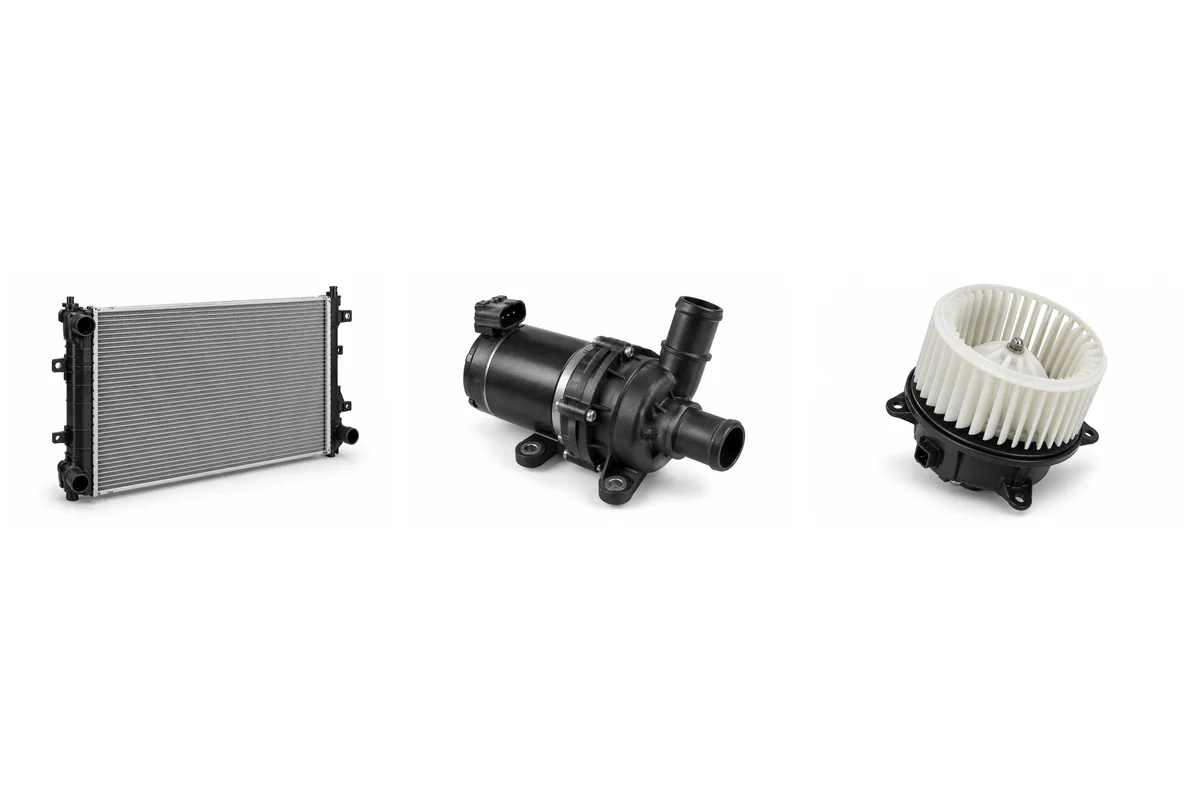
Identify the circuit before the component
A radiator, condenser and evaporator are not interchangeable finned cores. Use installed position, pipe connections and assembly markings to locate the requested item.
Document coolant routing at the vehicle
Record radiator hose exits, reservoir connections and the exact pump or valve location. A three-port valve still needs its flow map and control identity, while a pump requires its operating and connector specification. Do not infer the correct circuit from a generic product reference image.
Keep the refrigerant package sealed
Condenser, evaporator and pressure-sensor inquiries should retain the fitted heat-pump and market specification. Confirm receiver, seal and connection contents. Qualified refrigerant work is required; an electrical plug or matching pipe diameter is not sufficient compatibility evidence.
Separate airflow and speed control
A cabin blower motor and a speed-control module solve different repair needs. Confirm the diagnosis, steering-market HVAC housing, wheel depth and connector before ordering. Keep motor-only and controller-equipped supply explicitly separated.
Inspect the front airflow assembly
The cooling fan, shroud and active grille shutter must fit the actual front carrier and bumper revision. A decorative grille is not the powered louvre assembly. After front-end damage, check frame, mountings and harnesses rather than replacing only the most visible broken blades.
Keep high-voltage work outside a basic parts request
Traction-battery hardware, high-voltage compressor and power electronics need established handling, installation and transport arrangements. Their presence in the same thermal system does not make them part of an ordinary low-voltage or body-parts order.
Related selection checks
For a cabin airflow complaint, identify the cabin air filter restriction separately from the blower motor and blower control module; compare the HVAC housing before ordering an A/C evaporator.
Map the coolant route before comparing the motor cooling radiator, electric coolant pump, coolant reservoir and coolant control valve. Each assembly needs its own port and installed-location record.
Keep refrigerant-side A/C condenser, A/C evaporator and A/C pressure sensor identification separate from the external ambient temperature sensor; similar fault symptoms do not establish one common replacement.
Components to identify separately
| Assembly | Selection record |
|---|---|
| Motor Cooling Radiator | Named coolant circuit, core size, tank shape and hose exits |
| Cooling Fan Assembly | Shroud outline, mounting tabs, fan arrangement and control plug |
| Electric Coolant Pump | Installed circuit, operating voltage, port direction and control |
| Coolant Reservoir | Tank location, hose branches, cap specification and level sensing |
| Coolant Control Valve | Named circuit, port map, actuator and connector |
| A/C Condenser | Refrigerant pack, connection blocks, core and receiver arrangement |
| A/C Evaporator | HVAC housing, steering market, pipe bends and valve interface |
| Blower Motor | Air-box opening, cage depth, rotation and electrical socket |
| Blower Control Module | Installed marking, heat sink, flange and power connector |
| A/C Pressure Sensor | Refrigerant line location, thread, sealing face and signal |
| Ambient Temperature Sensor | External probe position, housing, bracket and lead |
Continue the order
Return to the Seal system directory. For commercial information, use the parts-list quotation guide; keep vehicle-specific identification with each requested assembly.
Auto parts inquiry
Send the vehicle and part evidence.
Include brand, full model, year, engine or EV drivetrain, OE/material code, quantity, destination and packing request. You can attach a list or old-part photos.