
Hyundai Tucson procurement guide
Hyundai Tucson Brake, Suspension, Steering and AWD Parts Guide
Use installed geometry and position to keep chassis and driveline orders precise.
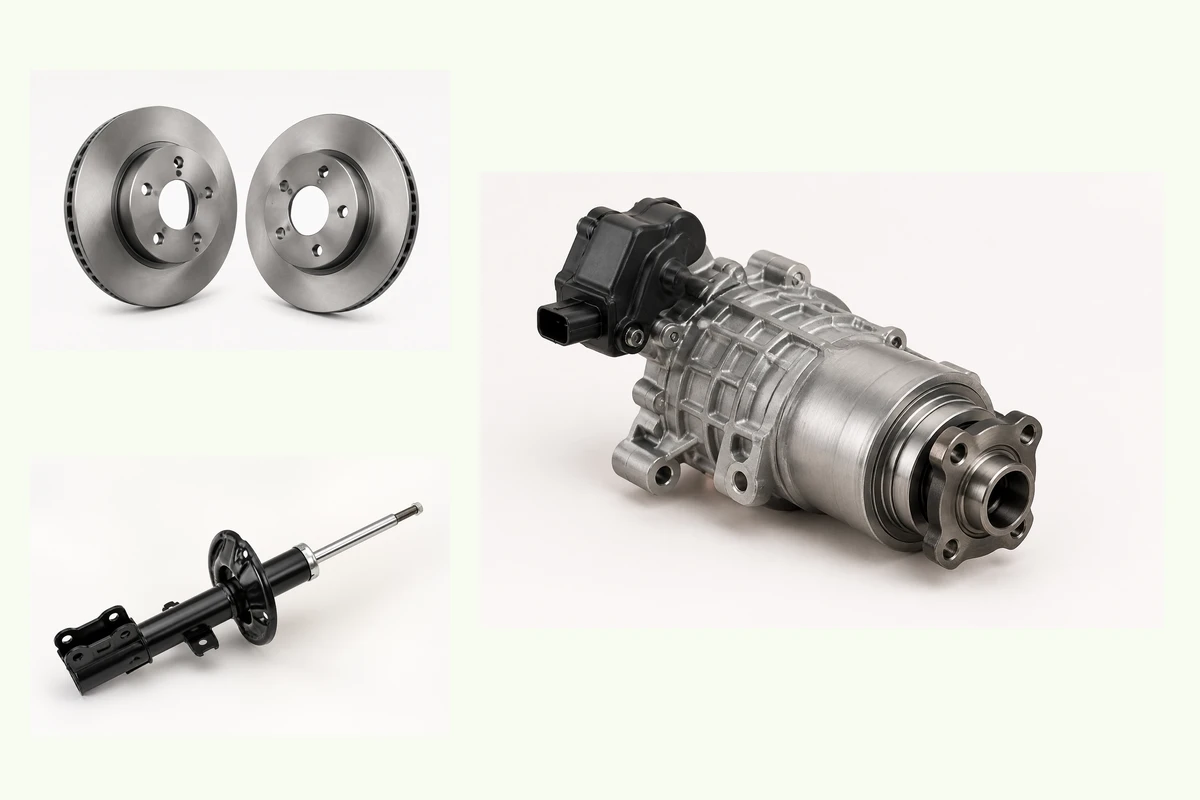
Record the complete corner
State axle, side, brake package, wheel or hub format and parking-brake arrangement.
Separate FWD and AWD
CV axles, propeller shafts, rear differentials, couplings and rear hardware require the actual drivetrain and transmission.
Define assembly boundaries
Arms, hubs, struts, calipers and differentials may be bare or include bushes, bearings, brackets, motors or modules.
Brakes & Parking Brake
Inspect front and rear hardware independently; Tucson trims and generations use both rear drum and rear disc arrangements.
| Component | Selection boundary |
|---|---|
For Tucson brake pads, start with axle, trim and caliper package; use backing-plate outline and dimensions and hardware, shim and wear-indicator scope to separate similar variants. | |
Specify Tucson brake discs by front or rear disc package. Retain diameter, thickness and overall height and bolt pattern and hub offset so offers describe the same assembly. | |
Build a Tucson brake shoes inquiry around rear drum service-brake application, then compare shoe arc, width and lever arrangement and springs and adjuster contents. | |
Match the Tucson brake caliper to axle, side and piston format. Record bracket centers and disc width together with hose and parking mechanism before sampling. | |
For Tucson brake master cylinder, start with brake-assist system and bore; use port locations and threads and reservoir and sensor contents to separate similar variants. | |
Specify Tucson brake booster by assist architecture. Retain stud pattern and rod arrangement and vacuum or control interfaces so offers describe the same assembly. | |
Build a Tucson brake hose inquiry around axle, side and suspension, then compare fitting type and threads and length and retaining brackets. | |
Match the Tucson abs wheel speed sensor to axle and sensor position. Record tone ring or encoder type together with lead length and connector before sampling. | |
For Tucson parking brake actuator, start with generation and rear brake package; use connector and actuator mounting and motor, cables or caliper relationship to separate similar variants. |
Suspension, Steering & Mounting
Match axle, side, chassis and steering system before comparing dampers, joints, hubs, shafts, mounts or subframes.
| Component | Selection boundary |
|---|---|
Specify Tucson shock absorber by front strut or rear damper position. Retain generation, trim and suspension package and spring seat and mounting geometry so offers describe the same assembly. | |
Build a Tucson strut mount inquiry around front strut design and side, then compare stud pattern and bearing format and rubber isolator and supplied pieces. | |
Match the Tucson coil spring to axle, trim and body load. Record free height, wire and end shape together with spring identification marks before sampling. | |
For Tucson control arm, start with independent-suspension position; use side and mounting geometry and bush and joint inclusion to separate similar variants. | |
Specify Tucson ball joint by axle, upper/lower position and side. Retain taper and retention method and separate joint or arm inclusion so offers describe the same assembly. | |
Build a Tucson tie rod end inquiry around steering system and position, then compare thread size and handedness and taper and joint orientation. | |
Match the Tucson stabilizer link to axle and roll-control layout. Record link centers and end type together with side and bracket orientation before sampling. | |
For Tucson wheel hub / bearing, start with axle and hub or pressed-bearing format; use abs encoder and wheel studs and spline, flange and mounting dimensions to separate similar variants. | |
Specify Tucson cv axle by axle, side and drivetrain. Retain inner flange or spline and compressed length and outer spline so offers describe the same assembly. | |
Build a Tucson steering rack inquiry around lhd/rhd and assist system, then compare mounting, input shaft and ratio and electrical connector or hydraulic ports. | |
Match the Tucson engine mount to engine code and mount position. Record bracket and stud pattern together with mount construction and controls before sampling. | |
For Tucson transmission mount, start with gearbox and transfer-case code; use crossmember and stud pattern and insulator and bracket inclusion to separate similar variants. | |
Specify Tucson front subframe / crossmember by generation and drivetrain. Retain steering-rack and control-arm mounts and bare frame or bush and bracket contents so offers describe the same assembly. | |
Build a Tucson propeller shaft inquiry around front or rear and wheelbase, then compare flange pilot diameter and bolt pattern and length and joint construction. | |
Match the Tucson rear differential to awd generation and powertrain. Record final-drive label and flange pattern together with bare unit or coupling and mount contents before sampling. | |
For Tucson awd coupling, start with awd generation and control type; use coupling label, flange and connector and pump, module and rear differential relationship to separate similar variants. | |
Specify Tucson axle shaft by rigid axle position and side. Retain spline and flange arrangement and length, bearing seats and seal seats so offers describe the same assembly. |
Continue with the same vehicle details
Use the Tucson parts directory to identify other assemblies. Once specifications are clear, retain quantities, packing and destination through the shipping and quotation guide.
Auto parts inquiry
Send the vehicle and part evidence.
Include brand, full model, year, engine or EV drivetrain, OE/material code, quantity, destination and packing request. You can attach a list or old-part photos.